
-1.svg "brillopak-automated-packing-machine-specialists- (2)-1")

By Brillopak on Nov 24, 2025 10:00:01 AM
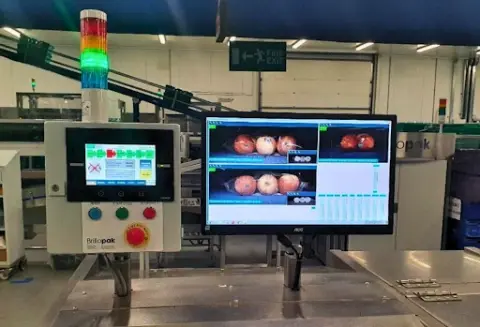
Every defective product that leaves your production line represents lost revenue. Every salvageable item discarded due to minor imperfections compounds that loss. For manufacturers operating high-speed packing lines, the margin between profitability and waste often comes down to one critical factor: the ability to identify, assess, and act on quality issues in real-time.
Manual inspection, however diligent, cannot deliver this capability at modern production speeds. The solution lies in automated vision systems that combine precision, speed, and intelligent decision-making to transform quality control from a bottleneck into a competitive advantage.

The Hidden Costs Of Manual Inspection
Manual inspection creates predictable problems in high-volume manufacturing environments. Inspectors fatigue, attention wavers, and consistency suffers across shifts. The consequences extend beyond the obvious: defective products reaching customers and salvageable items being unnecessarily discarded.
The real cost lies in opportunity: production lines throttled to accommodate human inspection speeds, yield losses from conservative rejection policies, and the inability to capture granular quality data that could drive continuous improvement.
Precision At Production Speed
Advanced vision systems eliminate these constraints through tireless, objective scrutiny at line speeds. Brillopak's Camera Independent Vision Software (CIVS™) integrates 3D laser vision with 2D colour resolution to inspect up to 800 products per minute, identifying defects, contaminants, and inconsistencies in size, shape, or colour that human inspectors would miss or flag incorrectly.
This technology operates independently of specific camera hardware, providing flexibility and consistency across different production environments. The system doesn't simply match human inspection capability—it fundamentally exceeds it, delivering repeatable accuracy that directly improves yield.
Intelligent Rejection: Reclaiming Value From The Reject Stream
Traditional quality control operates in binary terms: pass or fail. This approach discards significant value when products are rejected for minor, correctable issues rather than genuine contamination.
Advanced vision systems paired with intelligent handling can differentiate between categories of rejection. By scanning every product and using sophisticated robotic end effectors, these systems separate items requiring rework from those that must be discarded. Products with minor misalignment, incorrect orientation, or reworkable defects are redirected rather than wasted.
This capability transforms the reject stream from pure loss into a source of recovered value, directly improving overall yield whilst maintaining rigorous quality standards.
Comprehensive Pack Integrity Verification
Vision systems extend quality control beyond individual products to verify complete pack integrity throughout the packing process. They confirm accurate product counts, detect damaged packaging, and identify empty packs that could disrupt downstream automation.
For fresh produce, meat, poultry, and fish operations, vision systems detect contaminants around tray edges, verify seal integrity, and confirm correct labelling and date coding. This automated verification protects against the reputational and financial damage of product recalls whilst ensuring every item leaving the facility meets specification.
Enabling Precision Robotics
Robotic pick-and-place systems depend entirely on accurate positional data. Vision systems provide this critical information, measuring and inspecting products in motion to feed real-time coordinates to robotic handlers.
When products vary in shape, size, or orientation, common in fresh produce and food manufacturing, vision systems identify exact positioning and communicate adjustments to robotic end effectors. This integration between vision and handling enables consistent, high-speed operation whilst minimising product damage and handling errors that contribute to waste.
Transform Quality Control Into Yield Optimisation
Automated vision systems represent a strategic investment in operational efficiency. By moving beyond the limitations of manual inspection, manufacturers gain the capability to operate at full line speed whilst improving quality outcomes and recovering value from products that would otherwise be discarded.
For manufacturing operations seeking to maximise yield whilst maintaining rigorous quality standards, vision system integration delivers measurable returns through reduced waste, improved consistency, and enhanced throughput.
Discover How Vision Systems Can Optimise Your Operation
Brillopak's vision technology is proven across demanding fresh produce, meat, poultry, and ready meal applications. To discuss how automated inspection can improve yield in your specific manufacturing environment, book a free consultation today.

Navigating Staff Training With Automated Pick And Place Machines
Minimising Product Damage With A Pick And Place Automation System
No Comments Yet
Let us know what you think